
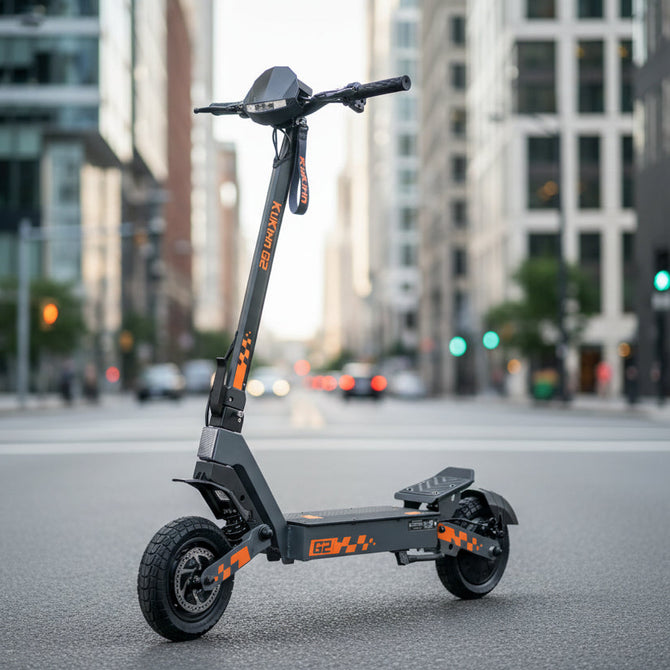
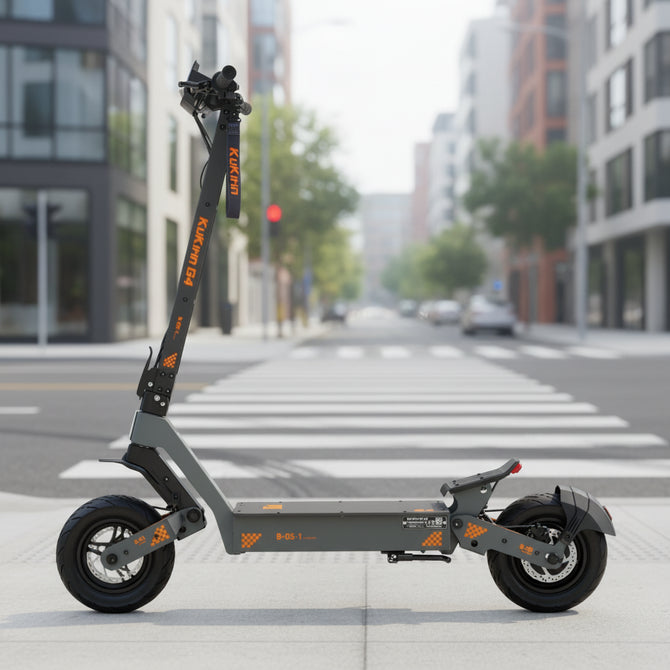
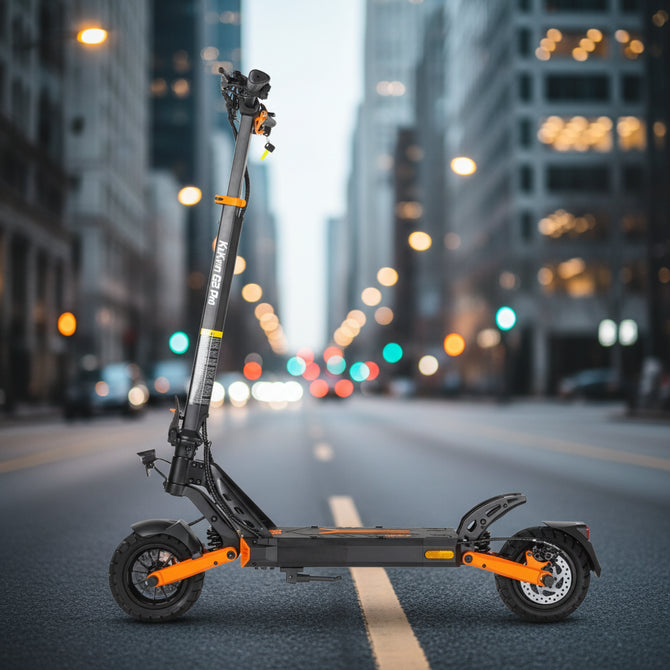

When people look at an electric scooter, the motors are usually the first thing they notice. A dual-motor scooter may have one motor on the front wheel and another on the rear wheel, creating a visibly more powerful setup.
But two motors alone do not explain how a dual-motor electric scooter actually works.
Behind those motors is a network of electronic components that must work together. The battery provides electrical energy, the controllers regulate that energy, sensors provide information, and the motors convert electrical power into mechanical movement.
KuKirin's dual-motor models provide useful examples of how this system is organized.
1. What Makes a Dual-Motor Scooter Different?
A single-motor electric scooter sends electrical power primarily to one driven wheel. A dual-motor scooter has two powered wheels, meaning the electronic system has to coordinate two motor drive units.
For example, the KuKirin G2 Master uses two motors, while the KuKirin G2 Ultra and G3 Pro are also designed around dual-motor configurations. These models demonstrate how electric scooter electronics can be arranged to support power delivery to both ends of the scooter.
The important point is that the two motors are not simply operating independently.
The electronic control system determines how electrical energy is delivered and how the motors respond to rider input.
When the rider twists the throttle, the system needs to interpret that input, communicate with the motor controllers, regulate current, and produce a controlled response.
That entire process happens extremely quickly.
2. The Battery: The Energy Source
Every electronic process begins with the battery.
An electric scooter battery stores electrical energy in a group of connected battery cells. When the scooter is switched on and the rider requests acceleration, this stored energy becomes available to the electronic control system.
In a dual-motor scooter, the battery needs to support the electrical demands of both motors.
This does not mean that the battery simply sends unlimited power to the motors. The controller acts as the electronic management layer between the battery and motors.
Battery voltage influences the electrical environment of the system, while battery capacity affects how much energy can be stored.
This is why dual-motor scooters often use relatively substantial battery systems. More motor capability can create greater electrical demand, particularly during acceleration, climbing, or demanding riding conditions.

3. The Controllers: The Electronic Brain
The controller is one of the most important components in an electric scooter.
In simple terms, it receives information from the rider and other electronic components, then controls how electrical power reaches the motor.
With a dual-motor configuration, the control architecture becomes more complex because two motors must be managed.
Think of the controller as a traffic manager.
The battery provides the available energy. The rider requests acceleration. The controller determines how the electrical system should respond.
The controller also works with other signals, such as throttle position, brake input, and system information.
This creates a continuous feedback process:
Rider input → Controller → Motor response → Wheel movement
In a dual-motor system, this becomes:
Rider input → Electronic control → Front motor + Rear motor → Wheel rotation
The result is a coordinated drive system rather than simply two unrelated motors.
4. Why Two Motors Can Improve Traction
One major benefit of a dual-motor configuration is that power can be delivered through two wheels.
Imagine riding on a surface where one wheel has less available grip. With only one driven wheel, all propulsion depends on that contact point.
With two driven wheels, propulsion is distributed across the front and rear wheels.
This can be useful when riding on inclines, uneven surfaces, loose terrain, or other situations where traction becomes more important.
However, traction is not created by motor power alone.
Tire design, road surface, rider weight, suspension, riding technique, and electronic control all affect how effectively power reaches the ground.

5. How the Two Motors Work Together
A dual-motor scooter must coordinate motor output with rider input.
When the rider activates dual-drive operation, both motors can contribute to propulsion. The electronic system needs to deliver power smoothly rather than simply switching both motors to maximum output.
This is particularly important during acceleration.
If power arrives too abruptly, the rider may experience an uncomfortable or difficult-to-control response. A well-managed electronic system can make acceleration more progressive.
This is where the relationship between throttle, controller, and motor becomes important.
The throttle provides the rider's command.
The controller processes that command.
The motor converts electrical energy into rotational force.
The wheel transfers that force to the tire.
The tire then interacts with the road.

6. KuKirin G2 Master: A Dual-Motor Example
The KuKirin G2 Master is a useful example of a performance-oriented dual-motor electronic architecture.
According to KuKirin's current EU product information, the G2 Master uses two 1000W motors and a 52V 20.8Ah battery. The official specifications list a maximum speed of 60 km/h and a maximum range of 70 km.

These numbers describe the hardware capability, but the interesting part from an electronics perspective is how that hardware is coordinated.
Two motors require the electrical system to manage power delivery across two drive units. The battery provides the energy, while the controllers regulate how that energy reaches the motors.
This allows the scooter to combine electrical power with traction from both wheels.
7. KuKirin G2 Ultra: Compact Dual-Motor Architecture
The KuKirin G2 Ultra provides another example.
Its official EU specifications list two 800W motors, a 48V 18Ah battery, a maximum speed of 50 km/h, and a maximum range of 55 km.

The important lesson is that dual-motor technology is not limited to one particular performance level.
Different scooters can use different motor and battery configurations while following the same basic electronic principle: energy storage, electronic control, motor drive, and wheel propulsion work together as one system.
8. KuKirin G3 Pro: Scaling the System
The KuKirin G3 Pro takes the dual-motor concept further with two 1200W motors and a 52V 23.4Ah battery. KuKirin's official EU specifications list a maximum speed of 65 km/h and a maximum range of 80 km.

This illustrates an important engineering principle.
Increasing motor capability also places greater demands on the supporting electronic system.
Battery capacity, controller capability, motor design, wiring, braking systems, cooling, and mechanical components all need to work as part of the overall architecture.
A powerful motor is therefore only one part of a complete electric scooter system.
9. Why Controllers Matter as Much as Motors
It is easy to think of an electric scooter's motor as the main source of performance.
In reality, the controller plays a critical role in determining how that motor behaves.
Two scooters can use powerful motors but feel very different because their electronic control systems, throttle response, riding modes, and power delivery characteristics differ.
This is why understanding electric scooter electronics can make specifications easier to interpret.
Instead of looking only at motor wattage, riders can consider the complete system:
- Battery voltage and capacity
- Motor configuration
- Controller architecture
- Throttle response
- Brake input
- Tire traction
- Cooling and protection
- Rider modes
These components work together to determine the riding experience.
10. The Complete Dual-Motor Energy Path
The complete process can be simplified into one chain:
Battery → Controller → Front Motor + Rear Motor → Wheels → Tires → Road
At the same time, another signal path is operating:
Throttle → Controller → Motor command
The two paths meet at the motors.
One path provides energy.
The other provides instructions.
The controller connects them.
This is the hidden electronic architecture behind dual-motor electric scooters.
Dual-motor electric scooters are more than scooters with two motors attached to two wheels. They are integrated electronic systems in which batteries, controllers, sensors, motors, tires, and mechanical components must work together.
KuKirin models such as the G2 Master, G2 Ultra, and G3 Pro demonstrate different approaches to dual-motor design. Their specifications show how motor configuration and battery systems can scale across different performance levels.
Once you understand the relationship between battery, controller, motor, wheel, and road, the technology behind a dual-motor electric scooter becomes much easier to understand.
The next time you twist the throttle, remember that you are not simply turning on a motor.
You are activating an entire electronic system designed to transform stored electrical energy into controlled motion.
Related reading:
👉 Click to visit our official KuKirin Shop website for more details.
👉The Hidden Technology Behind Every Throttle Twist


